Phukets Thai Herbs & Spices
The following are some essential Phuket herbs and spices used in Thai cooking in Restaurant in Bangtao, Phuket.
Thai herb is vegetables, plants and fruits that Thai people use as medicine and tonic. Thai herbs are the wonder because they can be used for internal and external purposes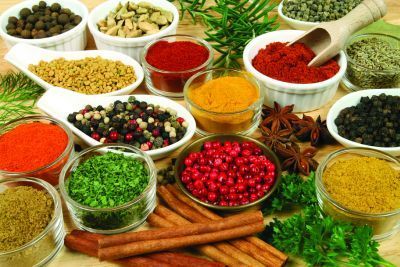 depending on the parts to be used or processed such as root, peel, resin, wood content, vine, tuber, flower or the whole tree. An herb has unimaginably amazing properties.
Basil (horapha, kaphrao, maenglak)
Horapha, kaphrao, maenglak are varieties of sweet basil. Horapha seems to be the nearest to the sweet basil used in European tomato dishes and Italian pesto. Horapha is used here as a vegetable and for flavouring. Fresh leaves are narrower and often tinged with reddish purple. It releases its aroma and flavour only when cooked and is used with fish, beef and chicken. Maenglak leaves are slightly hairy and paler green than Horapha. It is sometimes called lemon-scented basil but definitely has a peppery taste when chewed; it is very similar to Halian dwarf basil and is used as a vegetable and for flavouring.
Cinnamon (ob choei)
Form the bark of a tree, the type of cinnamon used in Thailand is of only one kind, that from the Cassia tree. It is used in meat dishes and particulary in massaman curry a garnish.
Bird Chlli (phrik khi nu)
The smallest of the chillies, of which the kind called phrik khi nu suan is the hottest. Take care when chopping them, and do not rub your eyes. Chillies stimulate blood circulation and are reputed to help prevent heart disease and cancer.
Chilli (Phrik chi fa)
Phrik chi fa are finger size, growing 9-12 centimetres in length, and ether yellow, red or green. Not as hot as the bird chilli. There is no discernable difference between the colours.
Citron (som sa)
Citron (Citrus medica var limetta) is a round dark green fruit. Its thick, very aromatic skin is much used for flavouring. Sour orange juice and orange peel would make the best substitute.
Cloves (kanphlu)
Cloves (Eugenia aromatica) are the dried flowerbuds of an evergreen tree native to the Molucca Islands. They are almost as expensive as saffron because crops often fail, they are much used in Western cooking and the oil is antiseptic. Cloves are used in massaman curry and to chew as a relief for toothache.
Coriander (phak chee)
The leaves are often chosen for decoration, with stem and roots for seasoning. Heavily used in Asian kitchens, the Thai kitchen is the only one to use the roots as well.
Cumin (yira)
Seeds look like caraway and fennel, but taste quite different and have to be heated to release their aroma. Only cumin is used in Thai cooking, mainly in the making of curry pastes.
Galangal (kha)
Resembling an upturned claw, this member of the ginger family is a pale pink rhizome with a subtle citrus flavour. It is usually added in large pieces to impart flavour to fish or chicken stock, or used in making curry pastes. Fresh young ginger can be substituted, but you will not end up with the same flavour.
Garlic (krathiam)
Thailand is literally overflowing with garlic plants. Whole cloves, smashed garlic and garlic oil are used in almost every Thai dish. To make garlic oil, chop a handful of garlic, and fry it in plenty of hot oil until golden. The oil and the fried garlics can be stored in a jar for garnishing soup and for tossing with noodles and rice.
Ginger (khing)
Resembling a flat hand, ginger has over 400 members included in its family. Always choose young fresh ginger if available. Easily grated, it is eaten raw or cooked and is used widely in many Asian cuisines. Young ginger. pounded with a little salt, pepper and garlic is good too as a marinate for chicken or beef. Ginger is acknowledged to improve digestion and to counteract nausea and vomiting.
Krachai Krachai: No English common name for Krachai (Kaempferia pandurata). The tubers of this member of the ginger family look like a bunch of yellow brown fingers. Krachai is always added to fish curries, and peeled and served as a raw vegetable with the popular summer rice dish, khao chae.
Kaffir Lime Leaf (bai makrut)
From the kaffir lime, which has virtually no juice these fleshy green and glossy leaves resemble a figure eight. Imparting a unique flavour, they can be finely shredded and added to salads, or torn and added to soups and curries. Can be substituted with other lemon-flavoured herbs, but the best option is to freeze the leaves when you can find them, as they retain all their flavour and texture on thawing
Lime (manao) Lime (manao)
The whole fruit is used. It is an excellent source of vitamin C and is used to enhance the flavour of chilli-hot condiments, as well as create some very special salads and desserts, and adorn most dishes as a condiment.
Lemongrass (takhrai)
This hard grass grows rapidly in almost any soil. The base of 10-12 centimetres length of the plant is used, with the green leafy part discarded. Young tender lemongrass stalks can be finely chopped and eaten, but older stalks should be cut into 3-5 centimetres lengths and bruised before being added only as a flavouring agent. It is indispensable for tom yam. Lemongrass oil will sooth an upset stomach and indigestion.
Mint (bai saranae)
This mint (Mentha arvensis) is similar to the mint used for mint sauce in England and is used in Thai food as a vegetable and a flavouring.
Nutmeg (luk chan)
The nut is enclosed in a very hard brown shell. It is used in the making of massaman curry paste.
Pandan Leaf (bai toei)
Long narrow green leaves of a herbaceous plant used for flavouring and colour. There is no substitute of the flavouring and colour. There is no substitute for the flavour but green colouring may be used as a substitute for the colour.
Pepper (prik thai)
Black, white and green peppercorn types. Black is milder and more aromatic than white. Green peppercorns have a special taste all their own and are available al year round but are best towards the end of the rainy season. Used as flavouring.
Sesame (nga) Sesame (nga): Identical to sesame seeds the world over. In Thai cooking, sesame seeds are used for oil and for flavouring. These tiny seeds are rich in protein.
Shallot (hom daeng)
These small, zesty, Thai red onions are sweet and aromatic. An essential ingredient in many Thai dishes because of their taste and appearance, they can be substituted with European shallots, small red onions or small brown onions.
Spring Onions (ton hom)
These green onions (Allium fistulosom) are used for garnishing soups and salads and as vegetables.
Turmeric (khamin)
These small, bright orange roots are used for the colouring in yellow curries. White turmeric, a different type, is used as a raw vegetable and resembles ginger. It taste only slightly peppery and has a pleasant tang.
Dried herbs and spices
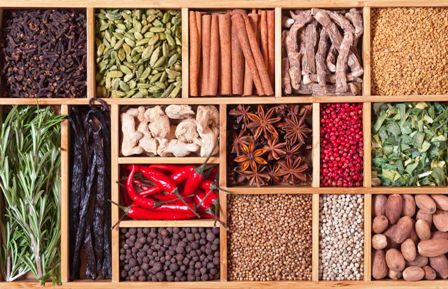
Bai yo – Noni leaves
Leaves are cooked with coconut milk in kaeng bai yo.
Buap hom – Luffa aegyptiaca
Used in stir-fries, in curries and in Kaeng type soups.
Buap liam – Luffa acutangula
Used in stir-fries and in Kaeng type soups.
Chaphlu – Piper sarmentosum
This leaf is used raw as a wrapper for the Thai dish Miang kham.
Fak thong – Kabocha
Used in curries, stir-fries, soups, salads and sweets.
Hom daeng – Shallot
Shallots, not onions, are essential for Thai cuisine. They are used for making Thai curry pastes, salads, and certain condiments and pickles. They are also served raw on the side with certain dishes such as khao soi.
Kalam pli – White cabbage
In Thai cuisine, cabbage is often served raw on the side with Thai salads such as som tam or lap, steamed or raw with nam phrik, or boiled in soups and curries.
Khanaeng – Cabbage sprouts
The sprouts that come up from the roots after the main cabbage has been harvested, are simply called khanaeng, meaning “sprouts”, or khanaeng kalam pli, “cabbage sprouts”.[4] They resemble and taste somewhat like brussels sprouts. It is often eaten stir-fried with, for instance, pork.
Khilek – Senna siamea
The leaves, tender pods and seeds are edible, but they must be previously boiled and the water discarded. One of the most well-known preparations is Kaeng khilek (แกงขี้เหล็ก).
Krachiap – Okra
It is usually served blanched or raw together with a Nam phrik (chilli dip), but it may be also served slightly barbecued or used in curries and stir-fried dishes.
Makhuea phuang – Pea eggplant
This pea sized eggplant is often used in curries and is indispensable in Nam phrik kapi, a chilli dip containing shrimp paste, where it is used raw.
Makhuea pro – Thai eggplant
About the size of a ping pong ball, these eggplants are used in curries or stir-fries, but they are also eaten raw with Nam phrik (Chilli dips).
Makhuea thet – Tomato
Literally meaning “foreign eggplant”, it is used in salad such as Som tam, as an ingredient in stir-fries such as in Thai fried rice, but also cooked to a thick sauce as in the chilli paste Nam phrik ong.
Mara – Bitter melon or bitter gourd
The small variety is most often eaten raw with Nam phrik. Popular is Tom chuet mara (Thai: ต้มจืดมะระ): bitter gourd in a clear broth, often stuffed with minced pork.
Marum – Drumstick
Most parts of the tree are edible: the long pods, the leaves, the flowers and the roots. Used in curries, stir-fries, soups, omelets, salads and also medicinal preparations.
No mai – Bamboo shoot
Used in stir-fried dishes and Thai curries.
No mai farang – Green asparagus.
Literally meaning “European bamboo shoot”, green asparagus is used mainly in vegetable stir-fries.
Phak bung – Morning-glory or water spinach
The large variety (Phak bung chin) is mostly eaten stir-fried or in soup. The small variety (Phak bung na) is generally served raw with Som tam or with Nam phrik.
Phak chi lom – Oenanthe javanica
Eaten in soups, curries, stir-fries and also raw. This is one of the vegetables known as Phak chi lom, the other is Trachyspermum roxburghianum.
Phak kat hongte – Bok choy
Used mainly in Thai-Chinese soups and stir-fries, this vegetable is known under several names in Thailand. Besides the aforementioned, it can also be called phak kat hongte (Thai: ผักกาด ฮ่องเต้), phak kwantung hongte (Thai: ผักกวางตุ้งฮ่องเต้), and phak kwantung Hong Kong (Thai: ผักกวางตุ้งฮ่องกง). Hongte, derived from the Chinese Hokkien dialect, means “Emperor (of China)”, and kwantung is the Thai word for Guangdong, a province of China. The “Hong Kong” variety of bok choy is generally larger and sweeter than the bok choy known under the other names.
Phak kat khao – Chinese cabbage
Literally “white cabbage”, it is often eaten in soups and stir-fried dishes but also raw, sliced very thin, with certain spicy noodle soups or raw with Nam phrik.
Phak kat khiao – Mustard greens
Literally “green cabbage”, it is often eaten in soups and stir-fried dishes.
Phak khana – Chinese broccoli or Kai-lan
Mostly eaten stir-fried with oyster sauce.
Phak khayaeng – Limnophila aromatica
Eaten raw with Nam phrik. Popular in Isan.
Phak khom – Amaranthus spp.
Used in salads and in soups like Tom chap chai and Tom kha mu. Mostly hybrids are offered in the market. The red-leafed Amaranth is known as Phak khom bai daeng (Thai: ผักขมใบแดง)
Phak krachet – Water mimosa
Usually eaten raw with Nam phrik. Popular in Isan.
Phak krathin – Leucaena leucocephala
Tender pods or seeds are eaten raw with Nam phrik.
Phak kwangtung – Choy sum
Literally “Guangdong greens”, it is often eaten in soups and stir-fried dishes.
Phak sian – Spider plant
The leaves are a popular food item fermented with rice water as Phak sian dong pickle.
Phak waen – Marsilea crenata
Eaten raw with Nam phrik. Popular in Isan.
Phak wan – Melientha suavis
Used in soups, mainly the sour soup of the kaeng type.
Riang – Tree bean
The young pods are edible.
Sato khao – Stink bean
The seeds of the Parkia speciosa (inside the pods) are usually eaten in stir fries.
Taengkwa – Cucumber
Typical Thai cucumbers are small. Eaten raw with Nam phrik or as a Som tam ingredient.
Talapat ruesi – Limnocharis flava
Eaten in soups, curries and stir-fries. Popular in Isan. It is popularly known as Phak phai (Thai: ผักพาย), not to be confused with Phak phai (Thai: ผักไผ่), the leaves of Persicaria odorata, another type of edible leaf.[6]
Thua fak yao – Yardlong beans
A very versatile bean, it is used in curries and stir-fried dishes, but also served raw in Som tam salad or together with a Nam phrik (chilli dip).
Thua ngok – Bean sprouts
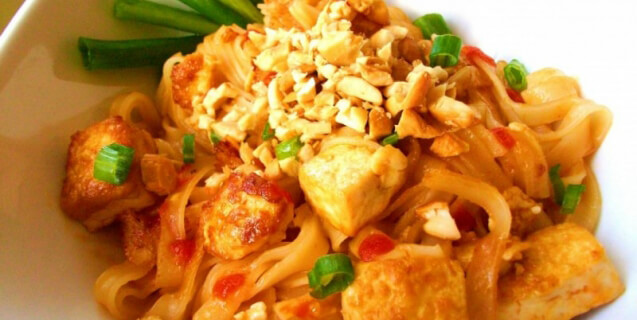
It is often eaten in soups and stir-fried dishes. Thais tend to eat bean sprouts raw to semi-raw, for instance in Phat Thai noodles where it is either sprinkled on top of the finished dish raw or added into the pan for one quick stir before serving
Thua phu – Winged bean
Often eaten raw with Nam phrik.
Thua rae – Soybean
Pods are boiled and seeds are eaten as a snack with salt.
HOME
 Restaurants & Food in Bangtao, Phuket